Sunday, April 27, 2008

THE AMAZING HERBAL_WORMSEED_LEVANT


Wormseed, Levant


Botanical: Artemisia cina (BERG.)

Family: N.O. Compositae


>Constituents
>Medicinal Action and Uses
>Preparations

---Synonyms---Sea Wormwood. Santonica. Semen Sanctum. Semen Cinae. Semen Contra. Semen Santonici. Artemesia Lercheana. Artemisia maritima, var. Stechmanniana. Artemisia maritima, var. pauciflora. Artemesia Chamaemelifolia. (Italian) Semenzina.

---Part Used---Seeds.

.......................................................................................................................
The Levant Wormseed, largely imported into Britain, is derived from a variety of the Sea Wormwood. Several species of Wormwood are mentioned by Dioscorides as being effective as a vermifuge, one of which was reported as growing in the country of the Santones in Gaul. Its ancient reputation has been maintained in modern times, for the universally employed vermifuge Santonin (the very name derived from classic days) is produced from Santonica - popularly called Wormseed - which consists of the minute, dried, unexpanded flower-heads of a Russian variety of the Sea Wormwood (Artemisia maritima, var. Stechmanniana, Bess.). This variety, which some botanists consider to be a distinct species, under the name of A. Cina (Berg.), or A. chamaemelifolia (Vill.), grows in profusion in Siberia, Turkestan and Chinese Mongolia. The greater part of the Wormseed is used in Turkestan, where it grows in enormous quantities in the desert of the Kirghiz, especially near the town of Chimkent, where a factory has been erected in which large quantities of Santonin are produced from the Wormseed collected in the vicinity, not more than 10 per cent of the drug being now exported in the crude state, in which condition it is known in this country as Levant Wormseed. The plant is low and shrubby, throwing up a number of erect stems on which the little greenish-yellow, oblong flower-heads are borne. Each head is about 1/8 inch long and 1/16 inch in diameter, and contains three to five minute, tubular flowers. In July and August, before the flowers expand, they are stripped from the stems and dried, being brought into Chimkent by the Kirghiz and other tribes.


Wormseed has long been used as an anthelmintic. Tragus, in 1531, in Brunfels' Herbal, mentions Wormseed as being imported by way of Genoa; it was employed in Italy under the name of Semenzina (diminutive of Semenza, seed), in the belief that it consisted of small seeds. From this word is derived the name of Semen cinae, by which the drug is often known: Semen contra (another of its names) is an abbreviation of Semen contra vermes. The drug at first sight appears to consist of a number of small brownish, ridged seeds, and it is not till they are closely examined that their true nature becomes apparent.


The drug exhales when crushed an agreeable aromatic odour, and possesses a bitter, aromatic camphoraceous taste. As imported, it frequently contains considerable fragments of the leaves and slender flower-stalks.


[Top]


---Constituents---The chief constituent of Wormseed is a crystalline principle, Santonin, to which the anthelmintic property of the drug is due. Santonin attains its maximum 2.3 to 3.6 per cent in July and August; after the flowerheads have expanded, it rapidly diminishes in quantity. It is extracted from the flower-heads by treating them with Milk of Lime, the Santonin being converted into soluble calcium santonate. It occurs in colourless, shining, flat prisms, without odour and almost tasteless at first, but afterwards developing a bitter taste. It is sparingly soluble in water, but soluble in alcohol and ether.


Wormseed also contains a crystalline substance, Artemisin, and a yellow volatile oil consisting of Cineol, to which its odour is due.


---Medicinal Action and Uses---Wormseed is one of the oldest and most common anthelmintics, especially for children. In domestic practice the seeds are used powdered, combined with honey or treacle, the dose of the seeds taken thus in substance being 10 to 30 grains. The seeds have also been employed in infusion or decoction, but in these forms their bitterness is a strong objection. As a general rule, however, the crude drug Wormseed is seldom administered, its active constituent Santonin being employed. It acts as a direct poison to parasites, and is used as a remedy for round-worms, which it rapidly expels; it has also an effect on thread-worms to a lesser degree, but has no action on tapeworms. It is usually administered as a powder or in lozenges, not in solution, and is often given with calomel, or compound powder of scammony.


---Preparations---Santonin, 2 to 5 grains. Santonin lozenges, B.P.


Several cases are on record of fatal poisoning by Santonin, and Santonin rendered yellow by exposure to direct sunlight is sometimes preferred, it being stated to be less poisonous. It is known as yellow Santonin, or Photosantonin.


Even small doses of Santonin will produce remarkable effects on the vision, appreciation of colour being so disturbed that objects appear to have a yellowish tinge, which is sometimes preceded by a faint colour. Santonin may also cause headache, nausea and vomiting, and in large doses, epileptiform convulsions.


See:

MUGWORT

WORMWOOD


[Top]


Common Name Index

THE AMAZING HERBAL Home Page

THE AMAZING HERBAL_WORMWOODS

Wormwoods

Botanical: N.O. Compositae
Wormwood, Common
>Wormwood, Roman
>Wormwood, Sea
The Wormwoods are members of the great family of Compositae and belong to the genus Artemisia, a group consisting of 180 species, of which we have four growing wild in England, the Common Wormwood, Mugwort, Sea Wormwood and Field Wormwood. In addition, as garden plants, though not native, Tarragon (A. dracunculus) claims a place in every herb-garden, and Southernwood (A. abrotanum), an old-fashioned favourite, is found in many borders, whilst others, such as A. sericea, A. cana and A. alpina, form pretty rockwork shrubs.

The whole family is remarkable for the extreme bitterness of all parts of the plant: 'as bitter as Wormwood' is a very Ancient proverb.

In some of the Western states of North America there are large tracts almost entirely destitute of other vegetation than certain kinds of Artemisia, which cover vast plains. The plants are of no use as forage: and the few wild animals that feed on them are said to have, when eaten, a bitter taste. The Artemisias also abound in the arid soil of the Tartarean steppes and in other similar situations.

The genus is named Artemisia from Artemis, the Greek name for Diana. In an early translation of the Herbarium of Apuleius we find:

'Of these worts that we name Artemisia, it is said that Diana did find them and delivered their powers and leechdom to Chiron the Centaur, who first from these Worts set forth a leechdom, and he named these worts from the name of Diana, Artemis, that is Artemisias.'

[Top]
......................................................................................................................

WORMWOOD, COMMON


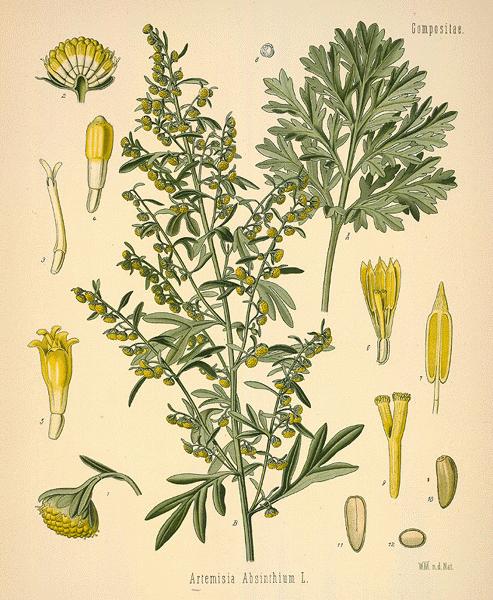
Botanical: Artemisia absinthium (LINN.)
Family: N.O. Compositae

>Description
>Cultivation
>Parts Used
>Constituents
>Medicinal Action and Uses
>Preparations

---Synonym---Green Ginger.
---Part Used---Whole Herb.
---Habitat---Europe, Siberia, and United States of America.

The Common Wormwood held a high reputation in medicine among the Ancients. Tusser (1577), in July's Husbandry, says:
'While Wormwood hath seed get a handful or twaine
To save against March, to make flea to refraine:
Where chamber is sweeped and Wormwood is strowne,
What saver is better (if physick be true)
For places infected than Wormwood and Rue?
It is a comfort for hart and the braine
And therefore to have it it is not in vaine.'
Besides being strewn in chambers as Tusser recommended, it used to be laid amongstuffs and furs to keep away moths and insects.

According to the Ancients, Wormwood counteracted the effects of poisoning by hemlock, toadstools and the biting of the seadragon. The plant was of some importance among the Mexicans, who celebrated their great festival of the Goddess of Salt by a ceremonial dance of women, who wore on their heads garlands of Wormwood.

With the exception of Rue, Wormwood is the bitterest herb known, but it is very wholesome and used to be in much request by brewers for use instead of hops. The leaves resist putrefaction, and have been on that account a principal ingredient in antiseptic fomentations.

An Old Love Charm

'On St. Luke's Day, take marigold flowers, a sprig of marjoram, thyme, and a little Wormwood; dry them before a fire, rub them to powder; then sift it through a fine piece of lawn, and simmer it over a slow fire, adding a small quantity of virgin honey, and vinegar. Anoint yourself with this when you go to bed, saying the following lines three times, and you will dream of your partner "that is to be":
"St. Luke, St. Luke, be kind to me,
In dreams let me my true-love see." '
Culpepper, writing of the three Wormwoods most in use, the Common Wormwood, Sea Wormwood and Roman Wormwood, tells us: 'Each kind has its particular virtues' . . . the Common Wormwood is 'the strongest,' the Sea Wormwood, 'the second in bitterness,' whereas the Roman Wormwood, 'to be found in botanic gardens' - the first two being wild - 'joins a great deal of aromatic flavour with but little bitterness.'

The Common Wormwood grows on roadsides and waste places, and is found over the greater part of Europe and Siberia, having been formerly much cultivated for its qualities. In Britain, it appears to be truly indigenous near the sea and locally in many other parts of England and Scotland, from Forfar southwards. In Ireland it is a doubtful native. It has become naturalized in the United States.

---Description---The root is perennial, and from it arise branched, firm, leafy stems, sometimes almost woody at the base. The flowering stem is 2 to 2 1/2 feet high and whitish, being closely covered with fine silky hairs. The leaves, which are also whitish on both sides from the same reason, are about 3 inches long by 1 1/2 broad, cut into deeply and repeatedly (about three times pinnatifid), the segments being narrow (linear) and blunt. The leaf-stalks are slightly winged at the margin. The small, nearly globular flowerheads are arranged in an erect, leafy panicle, the leaves on the flower-stalks being reduced to three, or even one linear segment, and the little flowers themselves being pendulous and of a greenish-yellow tint. They bloom from July to October. The ripe fruits are not crowned by a tuft of hairs, or pappus, as in the majority of the Compositae family.

The leaves and flowers are very bitter, with a characteristic odour, resembling that of thujone. The root has a warm and aromatic taste.

---Cultivation---Wormwood likes a shady situation, and is easily propagated by division of roots in the autumn, by cuttings, or by seeds sown in the autumn soon after they are ripe. No further care is needed than to keep free from weeds. Plant about 2 feet apart each way.

---Parts Used---The whole herb - leaves and tops - gathered in July and August, when the plant is in flower and dried.

Collect only on a dry day, after the sun has dried off the dew. Cut off the upper green portion and reject the lower parts of the stems, together with any discoloured or insect-eaten leaves. Tie loosely in bunches of uniform size and length, about six stalks to a bunch, and spread out in shape of a fan, so that the air can get to all parts. Hang over strings, in the open, on a fine, sunny, warm day, but in half-shade, otherwise the leaves will become tindery; the drying must not be done in full sunlight, or the aromatic properties will be partly lost. Aromatic herbs should be dried at a temperature of about 70 degrees. If no sun is available, the bunches may be hung over strings in a covered shed, or disused greenhouse, or in a sunny warm attic, provided there is ample ventilation, so that the moist heated air may escape. The room may also be heated with a coke or anthracite stove, care being taken that the window is kept open during the day. If after some days the leaves are crisp and the stalks still damp, hang the bunches over a stove, when the stalks will quickly finish drying. Uniformity in size in the bunches is important, as it facilitates packing. When the drying process is completed, pack away at once in airtight boxes, as otherwise the herbs will absorb about 12 per cent moisture from the air. If sold to the wholesale druggists in powdered form, rub through a sieve as soon as thoroughly dry, before the bunches have had time to absorb any moisture, and pack in tins or bottles at once.

---Constituents---The chief constituent is a volatile oil, of which the herb yields in distillation from 0.5 to 1.0 per cent. It is usually dark green, or sometimes blue in colour, and has a strong odour and bitter, acrid taste. The oil contains thujone (absinthol or tenacetone), thujyl alcohol (both free and combined with acetic, isovalerianic, succine and malic acids), cadinene, phellandrene and pinene. The herb also contains the bitter glucoside absinthin, absinthic acid, together with tannin, resin, starch, nitrate of potash and other salts.

---Medicinal Action and Uses---Tonic, stomachic, febrifuge, anthelmintic.

A nervine tonic, particularly helpful against the falling sickness and for flatulence. It is a good remedy for enfeebled digestion and debility.

---Preparations---Fluid extract, 1/2 to 1 drachm. Wormwood Tea, made from 1 OZ. of the herb, infused for 10 to 12 minutes in 1 pint of boiling water, and taken in wineglassful doses, will relieve melancholia and help to dispel the yellow hue of jaundice from the skin, as well as being a good stomachic, and with the addition of fixed alkaline salt, produced from the burnt plant, is a powerful diuretic in some dropsical cases. The ashes yield a purer alkaline salt than most other vegetables, except Beanstalks and Broom.

The juice of the larger leaves which grow from the root before the stalk appears has been used as a remedy for jaundice and dropsy, but it is intensely nauseous. A light infusion of the tops of the plant, used fresh, is excellent for all disorders of the stomach, creating an appetite, promoting digestion and preventing sickness after meals, but it is said to produce the contrary effect if made too strong.

The flowers, dried and powdered, are most effectual as a vermifuge, and used to be considered excellent in agues. The essential oil of the herb is used as a worm-expeller, the spirituous extract being preferable to that distilled in water. The leaves give out nearly the whole of their smell and taste both to spirit and water, but the cold water infusions are the least offensive.

The intensely bitter, tonic and stimulant qualities have caused Wormwood not only to be an ingredient in medicinal preparations, but also to be used in various liqueurs, of which absinthe is the chief, the basis of absinthe being absinthol, extracted from Wormwood. Wormwood, as employed in making this liqueur, bears also the name 'Wermuth' - preserver of the mind - from its medicinal virtues as a nervine and mental restorative. If not taken habitually, it soothes spinal irritability and gives tone to persons of a highly nervous temperament. Suitable allowances of the diluted liqueur will promote salutary perspiration and may be given as a vermifuge. Inferior absinthe is generally adulterated with copper, which produces the characteristic green colour.

The drug, absinthium, is rarely employed, but it might be of value in nervous diseases such as neurasthenia, as it stimulates the cerebral hemispheres, and is a direct stimulant of the cortex cerebri. When taken to excess it produces giddiness and attacks of epileptiform convulsions. Absinthium occurs in the British Pharmacopoeia in the form of extract, infusion and tincture, and is directed to be extracted also from A. maritima, the Sea Wormwood, which possesses the same virtues in a less degree, and is often more used as a stomachic than the Common Wormwood. Commercially this often goes under the name of Roman Wormwood, though that name really belongs to A. Pontica. All three species were used, as in Culpepper's time.

Dr. John Hill (1772) recommends Common Wormwood in many forms. He says:

'The Leaves have been commonly used, but the flowery tops are the right part. These, made into a light infusion, strengthen digestion, correct acidities, and supply the place of gall, where, as in many constitutions, that is deficient. One ounce of the Flowers and Buds should be put into an earthen vessel, and a pint and a half of boiling water poured on them, and thus to stand all night. In the morning the clear liquor with two spoonfuls of wine should be taken at three draughts, an hour and a half distance from one another. Whoever will do this regularly for a week, will have no sickness after meals, will feel none of that fulness so frequent from indigestion, and wind will be no more troublesome; if afterwards, he will take but a fourth part of this each day, the benefit will be lasting.'
He further tells us that if an ounce of these flowers be put into a pint of brandy and let to stand six weeks, the resultant tincture will in a great measure prevent the increase of gravel - and give great relief in gout. 'The celebrated Baron Haller has found vast benefit by this; and myself have very happily followed his example.'
......................................................................................................................

WORMWOOD, ROMAN

Botanical: Artemesia pontica
Family: N.O. Compositae
---Part Used---Herb.

Roman Wormwood (Artemesia Pontica) is not indigenous to this country, being a native of Southern Europe. It grows about the same height as the Common Wormwood, but has smaller and more finely cut leaves, the segments being narrower, the upper leaves more resembling those of Southernwood; the leaves are white with fine hairs on both upper and under surfaces.
The flowers, which blossom in July, are numerous, at the tops of the branches, and are darker and much smaller than those of Common Wormwood.

This is the most delicate though the least strong of the Wormwoods; the aromatic flavour with which its bitterness is mixed causes it to be employed in making the liqueur Vermuth.

Medicinally, the fresh tops are used, and also the whole herb, dried. Much of the A. Pontica in commerce is A. maritima.

Culpepper considered the Roman Wormwood 'excellent to strengthen the stomach.' Also that 'the juice of the fresh tops is good against obstructions of the liver and spleen. . . . An infusion of the flowering tops strengthens digestion. A tincture is good against gravel and gives great relief in the gout.'

Dr. John Hill says of this plant that it is the 'most delicate, but of least strength. The Wormwood wine, so famous with the Germans, is made with Roman Wormwood, put into the juice and work'd with it; it is a strong and an excellent wine, not unpleasant, yet of such efficacy to give an appetite that the Germans drink a glass with every other mouthful, and that way eat for hours together, without sickness or indigestion.'
......................................................................................................................

WORMWOOD, SEA

Botanical: Artemesia maritima
Family: N.O. Compositae
---Synonym---Old Woman.
---Parts Used---Young flowering tops and shoots.
---Habitat---In Britain it is found as far-as Wigton on the West and Aberdeen on the East; also in north-east Ireland and in the Channel Islands.

The Sea Wormwood, in its many variations of form, has an extremely wide distribution in the northern hemisphere of the Old World, occurring mostly in saltish soils. It is found in the salt marshes of the British Isles, on the coasts of the Baltic, of France and the Mediterranean, and on saline soils in Hungary; thence it extends eastwards, covering immense tracts in Southern Russia, the region of the Caspian and Central Siberia to Chinese Mongolia.

---Description---It somewhat resembles Artemesia Absinthium, but is smaller. Thestems rise about a foot or 18 inches in height. The leaves are twice pinnatifid, with narrow, linear segments, and, like the whole plant, are covered on both sides with a white cottony down. The small, oblong flower-heads - each containing three to six tubular florets - are of a yellowish or brownish tint; they are produced in August and September, and are arranged in racemes, sometimes drooping, sometimes erect.

Popularly this species is called 'Old Woman,' in distinction to 'Old Man' or Southernwood, which it somewhat resembles, though it is more delicate-looking and lacks the peculiar refreshing scent of 'Old Man.'

Dr. Hill says of this species:
'This is a very noble bitter: its peculiar province is to give an appetite, as that of the Common Wormwood is to assist digestion; the flowery tops and the young shoots possess the virtue: the older Leaves and the Stalk should be thrown away as useless. . . . The apothecaries put three times as much sugar as of the ingredient in their Conserves; but the virtue is lost in the sweetness, those will not keep so well that have less sugar, but 'tis easy to make them fresh as they are wanted.'
The plant abounds in salt marshes in which cattle have been observed to fatten quickly, and thus the herb has acquired the reputation of being beneficial to them, but they do not eat it generally, and the richness of maritime pasturage must be regarded as the true reason of their improvement under such circumstances.

---Part Used---The flowering tops and young shoots are used, collected and dried in the same manner as Wormwood.

---Medicinal Action and Uses---The plant possesses the same properties as the otherWormwoods, but is less powerful. It is a bitter tonic and aromatic.

Although it is not now employed in regular medical practice, it is often made use of by country people for intermittent fever, and for various other medicinal purposes instead of the true Wormwood.

Thornton, in his Family Herbal, tells us that:
'beat up with thrice its weight of fine sugar, it is made up into a conserve ordered by the London College, and may be taken where the other preparations disgust too much.'

It acts as a tonic and is good in worm cases, and Culpepper gives the following uses for it:
'Boiling water poured upon it produces an excellent stomachic infusion, but the best way is taking it in a tincture made with brandy. Hysteric complaints have been completely cured by the constant use of this tincture. In the scurvy and in the hypochondriacal disorders of studious, sedentary men, few things have a greater effect: for these it is best in strong infusion. The whole blood and all the juices of the body are effected by taking this herb. It is often used in medicine instead of the Roman Wormwood, though it falls far short of it in virtue.'
See:

[Top]

THE AMAZING HERBAL


Woundwort, Hedge
Botanical: Stachys sylvatica (LINN.)
Family: N.O. Labiatae
---Part Used---Herb.
......................................................................................................................
The Hedge Stachys, or Hedge Woundwort, the most frequent of the Stachys, is a coarse, hairy, malodorous plant, common in woods and hedges. It has thick, creeping roots that throw up tall stems, 2 or 3 feet high. Like the rest of the genus and labiate plants in general, these are quadrangular, but instead of being hollow (like the Deadnettles) they are filled with pith and solid; they are very hairy and often more or less red in colour.

The stem branches a good deal, though the upright character of the plant is preserved, the branches being very similar in character to the main stem and issuing from it in pairs, opposite to each other, at the same spot from which the leaf-stalks arise, the leaves being thrown off from the stem in pairs, each at right angles to the pair above and below it. The blades of the leaves are heart-shaped, similar in form to those of the nettle, with bold, saw-like teeth to the margins, and are on rather long footstalks.

The flowers grow in rings or whorls upon the stem, as in the other species of Stachys, each ring having narrow, leafy bracts beneath it, and being separated from the other by an intervening space of stem, the whole forming a long, terminal spike. There are rarely more than six flowers in each whorl. The lower lip of each flower is entire, beautifully variegated with white upon the dull crimson-purple ground and with its sides folded back. The upper lip is also entire and very convex, slightly viscid to the touch. The four stamens are beneath the protecting hood formed by the upper part of the flower, two of them longer than the others, their anthers first dull violet, then becoming black and containing pure white pollen. When in seed, the calyx teeth become rigid, and as the calyx tube dries and contracts, the four little nutlets enclosed are shot out. The corolla tube is often half filled with honey, and the mouth of the tube is provided with stiff white hairs to keep insect visitors to the centre of the channel, this flower laying itself out to be fertilized by hive bees, humble bees and long-tongued flies, who settle on the lower lip, and as they creep up the channel of the petal tube, get dusted with the pollen from the stamens in the hooded petal.

An old authority tells us that this herb 'stamped with vinegar and applied in manner of a pultis, taketh away wens and hard swellings, and inflammation of the kernels under the eares and jawes,' and also that the distilled water of the flowers 'is used to make the heart merry, to make a good colour in the face, and to make the vitall spirits more fresh and lively.'

It is said that a yellow dye can be obtained from the plant, and it has been suggested that the very tough fibres of its stem might be utilized commercially; it has also been classed among the Woundworts good for stanching blood. Referring to its pungent foetid smell when rubbed, Green, in his Universal Herbal (1832), considers that 'being one of those that powerfully affect the nerves, it might prove no contemptible stimulant if judiciously used.' He informs us also that toads are thought to be fond of living under its shade, and that though sheep and goats eat it, cows and hogs refuse it.

[Top]

THE AMAZING HERBAL

Woundwort, Marsh
Botanical: Stachys palustris (LINN.)
Family: N.O. Labiatae

Description

---Synonyms---All-Heal. Panay. Opopanewort. Clown's Woundwort. Rusticum Vulna Herba. Downy Woundwort.
---Part Used---Herb.

......................................................................................................................

The Marsh Woundwort is common in marshy meadows and by the sides of rivers and ditches in most parts of Great Britain.

---Description---From its root-stock, which is perennial, with numerous, white, fleshy, subterranean stolons, which creep in all directions, it throws up stout stems, 2 or 3 feet high, quadrangular, having many pairs of rather elongated, oblong leaves, tapering to a point and usually clasping the stem at the base. The light purple labiate flowers are arranged in a long spike terminating the stem, usually with only six flowers in each whorl. The long-stalked leaves that spring directly from the root, as in the Wood Betony, have mostly faded off by the time the flowers appear in late summer. The whole plant is very hairy.

This plant had formerly a great reputation as a vulnerary, being strongly recommended by Gerard in his Herbal. He tells us that once being in Kent, visiting a patient, he accidentally heard of a countryman who had cut himself severely with a scythe, and had bound a quantity of this herb, bruised with grease and 'laid upon in manner of a poultice' over the wound, which healed in a week, though it would 'have required forty daies with balsam itself.' Gerard continues:

'I saw the wound and offered to heal the same for charietie, which he refused, saying I could not heal it so well as himself - a clownish answer, I confesse, without any thanks for my good-will: whereupon I have named it "Clown's Woundwort." '
Parkinson gives the same origin of the name.

Gerard himself, according to his own account, afterwards 'cured many grievous wounds, and some mortale with the same herbe.' The plant was regarded as a valuable remedy in such cases long before Gerard's time, having long borne the names, among country people, All-heal and Woundwort. The Welsh have an ancient name for it bearing the same signification.

It has edible roots. These are tuberous and attain a considerable size; when boiled they form a wholesome and nutritious food, rather agreeable in flavour. The young shoots may likewise be eaten cooked like Asparagus, but though pleasant in taste they have a disagreeable smell.

In modern herbal medicine this plant (which is collected in July, when just coming into flower and dried in the same manner as Wood Betony) is employed for its antiseptic and antispasmodic properties. It relieves gout, cramp and pains in the joints and vertigo. The bruised leaves, which have an unpleasant odour and an astringent taste, when applied to a wound will stop bleeding and heal the wound, as is claimed for them by old tradition, and the fresh juice is made into a syrup and taken internally to stop haemorrhages, dysentery, etc.

[Top]

THE AMAZING HERBAL


"Y" Common Name Index

THE AMAZING HERBAL

Yam, Wild
Botanical: Dioscorea Villosa (LINN.)
Family: N.O. Dioscoreaceae

---Synonyms---Dioscorea. Colic Root. Rheumatism Root. Wilde Yamwurzel.
---Part Used---Dried rhizome.
---Habitat---Southern United States and Canada.

.....................................................................................................................

---Description---There are upwards of 150 varieties of Dioscorea, many, like the potato, being edible. An Indo-Chinese species is used as a dye in Southern China. Dioscorea Villosa is a perennial, twining plant, with long, knotty, matted, contorted, ligneous root-stocks. The root is long, branched, crooked, and woody, the taste being insipid, afterwards acrid, and having no odour. It is usually sold in pieces of various lengths, which are difficult to pulverize, as the root flattens out when this is attempted. The therapeutical value is lost after the first year, so that it should be freshly gathered and carefully dried each year.

---Constituents---Much saponin has been found in the roots, and a substance improperly called dioscorein, obtained by precipitating the tincture with water.

---Medicinal Action and Uses---Antispasmodic. Perhaps the best relief and promptest cure for bilious colic, especially helpful in the nausea of pregnant women. Valuable also in painful cholera morbus with cramps, neuralgic affections, spasmodic hiccough and spasmodic asthma.

---Dosage---1/2 to 1 drachm of fluid extract. Dioscorein, 1/4 to 4 grains.

---Poisonous, if any, with Antidotes---An alkaloid separated from the Javanese D. hirsuta has been found to be a convulsive poison, resembling picrotoxin, but much feebler.

[Top]

THE AMAZING HERBAL

Yarrow
Botanical: Achillea millefolium (LINN.)
Family: N.O. Compositae

>Description
>Parts Used
>Constituents
>Medicinal Action and Uses
>Preparations

---Synonyms---Milfoil. Old Man's Pepper. Soldier's Woundwort. Knight's Milfoil. Herbe Militaris. Thousand Weed. Nose Bleed. Carpenter's Weed. Bloodwort. Staunchweed. Sanguinary. Devil's Nettle. Devil's Plaything. Bad Man's Plaything. Yarroway.
(Saxon) Gearwe.
(Dutch) Yerw.
(Swedish) Field Hop.
---Part Used---Whole Herb.
---Habitat---Yarrow grows everywhere, in the grass, in meadows, pastures, and by the roadside. As it creeps greatly by its roots and multiplies by seeds it becomes a troublesome weed in gardens, into which it is seldom admitted in this country, though it is cultivated in the gardens of Madeira.
The name Yarrow is a corruption of the Anglo-Saxon name for the plant - gearwe; the Dutch, yerw.
........................................................................................................................

---Description---The stem is angular and rough, the leaves alternate, 3 to 4 inches long and 1 inch broad, clasping the stem at the base, bipinnatifid, the segments very finely cut, giving the leaves a feathery appearance.

It flowers from June to September, the flowers, white or pale lilac, being like minute daisies, in flattened, terminal, loose heads, or cymes. The whole plant is more or less hairy, with white, silky appressed hairs.

Yarrow was formerly much esteemed as a vulnerary, and its old names of Soldier's Wound Wort and Knight's Milfoil testify to this. The Highlanders still make an ointment from it, which they apply to wounds, and Milfoil tea is held in much repute in the Orkneys for dispelling melancholy. Gerard tells us it is the same plant with which Achilles stanched the bleeding wounds of his soldiers, hence the name of the genus, Achillea. Others say that it was discovered by a certain Achilles, Chiron's disciple. It was called by the Ancients, the Herba Militaris, the military herb.

Its specific name, millefolium, is derived from the many segments of its foliage, hence also its popular name, Milfoil and Thousand Weed. Another popular name for it is Nosebleed, from its property of stanching bleeding of the nose, though another reason given for this name is that the leaf, being rolled up and applied to the nostrils, causes a bleeding from the nose, more or less copious, which will thus afford relief to headache. Parkinson tells us that 'if it be put into the nose, assuredly it will stay the bleeding of it' - so it seems to act either way.

It was one of the herbs dedicated to the Evil One, in earlier days, being sometimes known as Devil's Nettle, Devil's Plaything, Bad Man's Plaything, and was used for divination in spells.

Yarrow, in the eastern counties, is termed Yarroway, and there is a curious mode of divination with its serrated leaf, with which the inside of the nose is tickled while the following lines are spoken. If the operation causes the nose to bleed, it is a certain omen of success:
'Yarroway, Yarroway, bear a white blow,
If my love love me, my nose will bleed now.'

An ounce of Yarrow sewed up in flannel and placed under the pillow before going to bed, having repeated the following words, brought a vision of the future husband or wife:
'Thou pretty herb of Venus' tree,
Thy true name it is Yarrow;
Now who my bosom friend must be,
Pray tell thou me to-morrow.'
---(Halliwell's Popular Rhymes, etc.)
It has been employed as snuff, and is also called Old Man's Pepper, on account of the pungency of its foliage. Both flowers and leaves have a bitterish, astringent, pungent taste.

In the seventeenth century it was an ingredient of salads.

[Top]

---Parts Used---The whole plant, stems, leaves and flowers, collected in the wild state, in August, when in flower.

---Constituents---A dark green, volatile oil, a peculiar principle, achillein, and achilleic acid, which is said to be identical with aconitic acid, also resin, tannin, gum and earthy ash, consisting of nitrates, phosphates and chlorides of potash and lime.

---Medicinal Action and Uses---Diaphoretic, astringent, tonic, stimulant and mild aromatic.

Yarrow Tea is a good remedy for severe colds, being most useful in the commencement of fevers, and in cases of obstructed perspiration. The infusion is made with 1 OZ. of dried herb to 1 pint of boiling water, drunk warm, in wineglassful doses. It may be sweetened with sugar, honey or treacle, adding a little Cayenne Pepper, and to each dose a teaspoonful of Composition Essence. It opens the pores freely and purifies the blood, and is recommended in the early stages of children's colds, and in measles and other eruptive diseases.

A decoction of the whole plant is employed for bleeding piles, and is good for kidney disorders. It has the reputation also of being a preventative of baldness, if the head be washed with it.

[Top]

---Preparations---Fluid extract, 1/2 to 1 drachm. An ointment made by the Highlanders of Scotland of the fresh herb is good for piles, and is also considered good against the scab in sheep.
An essential oil has been extracted from the flowers, but is not now used.

Linnaeus recommended the bruised herb, fresh, as an excellent vulnerary and styptic. It is employed in Norway for the cure of rheumatism, and the fresh leaves chewed are said to cure toothache.

In Sweden it is called 'Field Hop' and has been used in the manufacture of beer. Linnaeus considered beer thus brewed more intoxicating than when hops were used.

It is said to have a similar use in Africa.

Culpepper spoke of Yarrow as a profitable herb in cramps, and Parkinson recommends a decoction to be drunk warm for ague.

The medicinal values of the Yarrow and the Sneezewort (A. millefolium and A. ptarmica), once famous in physic, were discarded officially in 1781.

Woolly Yellow Yarrow (A. tomentosa) is very rare, and a doubtful native; its leaves are divided and woolly, the flowers bright yellow.

[Top]

THE AMAZING HERBAL

Yellow Dock

See Docks.

THE AMAZING HERBAL

Yellow Flag

See Irises.

THE AMAZING HERBAL

Yellow Parilla

See Parilla, Yellow.

THE AMAZING HERBAL

Yerba Reuma
Botanical: Frankenia grandifloria (CHAM. and SCHLECHT)
Family: N.O. Frankeniaceae
---Synonyms---Frankenia. Flux Herb.
---Part Used---Herb.
---Habitat---California, Nevada, Arizona and Northern Mexico.
...........................................................................................................................................................................

---Description---A small, shrubby plant, with a prostrate, much-branched stem, about 6 inches long, growing in sandy places. It is salty to the taste, leaving an astringent aftertaste. It has no odour.

---Constituents---It contains about 6 per cent of tannin.

---Medicinal Action and Uses---Astringent. The herb is used as a remedy in catarrhal affections, especially of the nose and genitourinary tract.
When diluted with from two to five times its volume of water, it may be used as an injection or spray.
It may also be taken internally.

---Dosage---Of fluid extract, 10 to 20 minims.

[Top]

THE AMAZING HERBAL

Yerba Santa
Botanical: Eriodictyon glutinosum (BENTH.)
Family: N.O. Hydrophyllaceae

>Description
>Constituents
>Medicinal Action and Uses
>Dosage
>Other Species

---Synonyms---Mountain Balm. Consumptive's Weed. Gum Bush. Bear's Weed. Holy or Sacred Herb. Eriodictyon Californicum (Hook and Arn.).
---Part Used---Dried leaves.
---Habitat---California, Northern Mexico.

........................................................................................................................................................................

---Description---A low, shrubby evergreen plant, 2 to 4 feet high, found growing abundantly in clumps on dry hills in California and Northern Mexico. The stem is smooth, usually branched near the ground, and covered with a peculiar glutinous resin, which covers all the upper side of the plant. Leaves, thick and leathery, smooth, of a yellowish colour, their upper side coated with a brownish varnish-like resin, the under surface being yellowish-white reticulated and tomentose, with a prominent midrib, alternate, attached by short petioles, at acute angle with the base; shape, elliptical, narrow, 2 to 5 inches long 3/4 inch wide, acute and tapering to a short leaf-stalk at the base. The margin of the leaf, dentate, unequal, bluntly undulate. The flowers, bluish, in terminal clusters of six to ten, in a one-sided raceme, the corolla funnel-like, calyx sparsely hirsute.

---Constituents---The chief constituents are five phenolic bodies, eriodictyol, homoeriodictyol, chrysocriol, zanthoeridol and eridonel. Free formic and other acids, glycerides of fatty acids; a yellow volatile oil; a phytosterol, a quantity of resin, some glucose. Taste, balsamic and sweetish, afterwards acrid, but not bitter, recalls Dulcamara and creates a flow of saliva. Odour, aromatic. The leaves are brittle when dry, but flexible in a warm, moist atmosphere. Eriodictyon Californicum is official in the United States Dispensary. Alcohol is the best agent for the fluid extract of the dried plant.

---Medicinal Action and Uses---Recommended for bronchial and laryngeal troubles and in chronic pulmonary affections, in the treatment of asthma and hay-fever in combination with Grindelia robusta. Likewise advised for haemorrhoids and chronic catarrh of the bladder. Much used in California as a bitter tonic and a stimulating balsamic expectorant and is a most useful vehicle to disguise the unpleasant taste of quinine. Male fern and Hydrastis. In asthma, the leaves are often smoked. Aromatic syrup is the best vehicle for quinine.

---Dosage---15 to 60 grains.

---Other Species---E. tomentosum, often found growing next to E. Californicum, especially in South California, but is easily distinguished from E. Californicum, being a larger shrub, and having a dense coat of short, villous hairs, colouring with age, whity-rusty; corolla, salver-shaped; leaves oval or oblong, and obtuse.

[Top]

Saturday, April 26, 2008

THE AMAZING HERBAL

YEW
Botanical: Taxus baccata
Family: N.O. Taxaceae and Coniferae

>Description
>Constituents
>Uses

---Poisonous Parts---Leaves, seed and fruit. ---Habitat---Europe, North Africa, Western Asia.

---Description---A tree 40 to 50 feet high, forming with age a very stout trunk covered with red-brown, peeling bark and topped with a rounded or wide-spreading head of branches; leaves spirally attached to twigs, but by twisting of the stalks brought more or less into two opposed ranks, dark, glossy, almost black-green above, grey, pale-green or yellowish beneath, 1/2 to 1 1/2 inches long, 1/16 to 1/12 inch wide. Flowers unisexual, with the sexes invariably on different trees, produced in spring from the leaf axils of the preceding summer's twigs. Male, a globose cluster of stamens; female, an ovule surrounded by small bracts, the so-called fruit bright red, sometimes yellow, juicy and encloses the seed.
No tree is more associated with the history and legends of Great Britain than the Yew. Before Christianity was introduced it was a sacred tree favoured by the Druids, who built their temples near these trees - a custom followed by the early Christians. The association of the tree with places of worship still prevails.
Many cases of poisoning amongst cattle have resulted from eating parts of the Yew.

---Constituents---The fruit and seeds seem to be the most poisonous parts of the tree. An alkaloid taxine has been obtained from the seeds; this is a poisonous, white, crystalline powder, only slightly soluble in water; another principle, Milossin, has also been found.

---Uses---The wood was formerly much valued in archery for the making of long bows. The wood is said to resist the action of water and is very hard, and, before the use of iron became general, was greatly valued. (In homoeopathy a tincture of the young shoots and also of the berries is used in a variety of diseases: cystitis, eruptions, headache and neuralgia, affections of the heart and kidneys, dimness of vision, and gout and rheurmatism. - EDITOR)

THE AMAZING HERBAL

Zedoary
Botanical: Curcuma zedoaria (ROSCOE)
Family: N.O. Zingiberaceae

>Description
>Constituents
>Medicinal Action and Uses
>Dosages

---Synonyms---Turmeric. Zitterwurzel.
---Part Used---Dried rhizome.
---Habitat---East Indies and Cochin-China.

---Description---There are two kinds of Zedoary, the long and the round, distinguished by the names of radix zedoaria longae (Curcuma Zerumbet, the Long Zedoary of the shops) and radix zedoaria rotundae. The long is in slices, or oval fingers; the round in transverse, rounded sections, twisted and wrinkled, greyish-brown in colour, hairy, rough, and with few root scars. The odour is camphoraceous, and the taste warm, aromatic, and slightly bitter, resembling ginger. The five commercial varieties come from China, Bengal, Madras, Java and Cochin-China, and vary in size and colour. When chewed they turn the saliva yellow. The powder is coloured brown-red by alkalis and boric acid. The Zerumbet has been erroneously confused with the round Zedoary.
Curcuma Starch, or East Indian Arrowroot, is prepared from the rhizomes of Curcuma angustifolia.
Some varieties of Zedoary are used as an ingredient in condiments and curries.

---Constituents---A volatile oil, when distilled with water, fixed oil, pungent resin, curcumin (an orange-yellow, tasteless, resinous principle), starch, mucilage, and an alkaloid.

---Medicinal Action and Uses---Aromatic, stimulant. Useful in flatulent colic and debility of the digestive organs, though it is rarely employed, as ginger gives the same, or better results. It is used as an ingredient in bitter tincture of Zedoary, antiperiodic pills (with and without aloes) bitter tincture, antiperiodic tincture (with and without aloes).

---Dosages---From 10 grains to 1/2 drachm. Fluid extract, 10 to 30 drops. Infusion of 1/2 OZ. to a pint of boiling water, 1 tablespoonful.


[Top]